

To the U.S. Department of Health and Human Services, Food and Drug Administration, and Health Resources and Services Administration:
I support a carefully defined pathway to regulate isolated, otherwise unmodified pancreatic islets recovered from deceased donors for transplantation under HRSA oversight of the Organ Procurement and Transplantation Network (OPTN). I ask HHS to proceed with that approach, with enforceable standards for isolation facilities, donor screening, allocation, release, traceability, clinical outcomes, and adverse-event reporting. The change should be limited to this defined donor-organ use and should preserve FDA oversight of engineered, expanded, stem-cell-derived, gene-edited, or otherwise substantially modified cellular products.
I write in my personal capacity as a physician-scientist, Professor of Surgery and Chief of Cellular Transplantation at the University of Miami, Director of its Cell Transplant Center, and Director Emeritus of its Diabetes Research Institute. I developed the automated human islet isolation method and participated in the NIH Clinical Islet Transplantation (CIT) Consortium, including its phase 3 program. I joined Dr. Piotr Witkowski in the Islets for US Collaborative’s May 2021 letter to Secretary Becerra, March 2025 letter to FDA Commissioner Makary, and March 2026 letter to Secretary Kennedy. These comments build on that correspondence and our published analyses, while addressing the specific questions in this notice. [1–3]
Direct answers to the two central questions
HHS asks whether an organ-transplant framework would improve access to deceased-donor islets for transplantation, and what safeguards would be needed to protect patients under that framework. My answer to the first question is yes. An organ pathway would remove the drug-licensure burden that has driven academic programs out of clinical practice; allow organ procurement organizations to offer pancreata to qualified islet programs through the OPTN; open a path to ordinary transplant coverage; and restore the clinical volume on which both patient care and U.S. leadership in cellular therapy depend. Regulatory classification is not the only barrier, and I address the others below, but it is the one HHS can change directly.
On the second question, the safeguards should match those of solid-organ transplantation and add islet-specific protections: accredited isolation facilities with validated processes and documented release; donor screening, traceability, and look-back; national patient-selection and informed-consent standards; monitoring for allosensitization; program-specific outcome reporting with performance thresholds; and a single national registry linked to OPTN data. Each is described in the sections that follow.
The clinical case and the appropriate boundary Questions A5 B3 B5
Pancreatic islets retain multicellular organ like structure with own vasculature and neural network as well as glucose-responsive endocrine function after isolation and infusion into patients [22,23,24]. When isolation and short-term preservation leave those relevant properties intact, it is scientifically reasonable to treat them as functional subparts of a donated pancreas for the specific purpose of transplantation. Current legislation also supports regulation of islets as other organs. National Organ Transplantation Act was amended in 1984 to include organ subparts to be regulated as organs. Consequently, since organs for transplantation are protected from commercialization, islets should also be protected and not regulated and commercialized as drugs. [21].
The European Medicines Agency has recognized that enzymatic digestion isolating functionally intact tissue units, including pancreatic islets, need not constitute substantial manipulation; this international experience is instructive, although U.S. statutory questions must be resolved under U.S. law. [4,5]
The NIH-sponsored phase 3 CIT-07 study enrolled adults with type 1 diabetes complicated by severe hypoglycemia despite intensive care. Its prespecified primary endpoint was met by 87.5% of participants at one year and 71% at two years. These results support access for carefully selected patients, not indiscriminate treatment of everyone with type 1 diabetes. Recipients also face the risks of portal infusion and chronic immunosuppression, and long-term insulin independence is variable. [6]
HHS should define the eligible material precisely: islets recovered from a donated human pancreas, isolated and preserved without expansion, genetic modification, differentiation from pluripotent cells, or changes that alter their relevant structural or physiological characteristics, and used for their native endocrine function. The final policy should explain how combination products, substantial culture, encapsulation, and other added manipulations are assessed. As I explained in a 2021 published interview, the graft contains intact multicellular islets, not a suspension of dissociated beta cells. That anatomical distinction helps explain the narrow scope of this proposal. [10] This boundary protects FDA jurisdiction where product development adds distinct manufacturing or clinical risks. It should not automatically reclassify other donor-derived cellular therapies.
Our March 2025 letter also highlighted a regulatory asymmetry: autologous pancreatic islets have been handled differently from comparable unrelated allogeneic islets, although isolation itself does not become more extensive because the recipient differs from the donor. Allogeneic use does add immunologic, donor-screening, and infection-control risks, which a transplant-specific framework must address directly. In the same letter we pointed to vascularized composite allografts as a precedent for an HHS regulatory decision to bring an additional category into the organ-transplant system. That precedent supports considering agency action here; it does not resolve the distinct statutory and operational questions for isolated islets. [2]
Evidence and release standards Questions A1 to A4 A6 to A14
The public record includes CIT-07 and CIT-06 publications, the eight-facility CIT manufacturing study, the Collaborative Islet Transplant Registry, U.S. IND experience, and long-running Canadian and European programs. HHS should convene an open evidence review that distinguishes efficacy evidence from evidence of reproducible processing. International outcomes can inform clinical benefit and risk; they do not establish that every foreign facility satisfies U.S. manufacturing requirements. Registry analyses should specify patient selection, baseline severe-hypoglycemia burden, endpoint definitions, follow-up completeness, repeat infusions, immunosuppression, and center effects. [6–8]
As proposed in our March 2025 letter, donor islet processing should operate under appropriate Good Tissue Practice and transplant-specific quality requirements, with independent oversight suited to the actual isolation process. Some requirements may need to be borrowed from cGMP regulations for islet processing, for example, a clean room environment. A release framework should document donor consent and eligibility, communicable-disease testing, pancreas procurement and ischemia, preservation, facility qualifications, validated isolation procedures, identity, islet equivalents and dose, viability, endocrine purity, process controls, endotoxin, microbiological testing, container integrity, transport conditions, and chain of identity and custody. Because definitive sterility culture results may arrive after a time-sensitive infusion, policy needs pre-infusion controls, a documented conditional-release decision, rapid notification, recipient management, and retrospective investigation. Functional assays and clinical outcomes should be evaluated together; no single pre-infusion purity or potency test reliably predicts the response of an individual graft. The FDA advisory discussion cited in our 2021 letter raised this very issue. It is a reason to design better, risk-based standards, not to relax safety oversight. [1,7]
For the narrow indication in the notice, I support harmonized endpoints for severe hypoglycemia, HbA1c, stimulated C-peptide, insulin use and independence, quality of life, kidney function, graft survival, and serious adverse events. Historical or external controls and high-quality real-world evidence may be informative where comparability and missing data are explicitly assessed. Standard intraportal infusion and established immunosuppression should be evaluated against their published experience; materially new routes or regimens merit their own safety review. Annual process review and continuous collection of late outcomes remain essential regardless of the statutory pathway. Similarly to whole organs, only OPTN islet transplant licensed transplant center will be eligible to carry out islet transplantation procedure. Expected safety and efficacy will be verified based on annual outcomes and administrative corrective actions will be implemented to maintain the standards. License to transplantation can be suspended or revoked.
Access and causation Questions B1 B2 B10
An organ-transplant framework would improve access through several concrete mechanisms.
Restoring academic programs. U.S. centers performed 179 islet allotransplants between 1999 and 2005, but only 11 new patients were transplanted between 2016 and 2019, all within clinical trials. When NIH-funded trials ended, centers faced a drug-licensure requirement that academic institutions are not structured to meet, and clinical practice largely stopped. An organ pathway would let qualified academic programs resume transplantation under transplant-appropriate oversight. [12,20]
Using donated pancreata that are now lost. Many pancreata from consented deceased donors are never recovered, or are recovered and not transplanted. In 2024, the United States had 16,989 deceased donors, yet only 878 pancreata were transplanted, just 31 of them as islets; one in four pancreata recovered for transplant (25.1%) was not transplanted, and 3,243 pancreata were recovered for research instead (Figure 1). [25,26] An organ pathway would allow these organs to be offered to qualified islet programs rather than discarded.
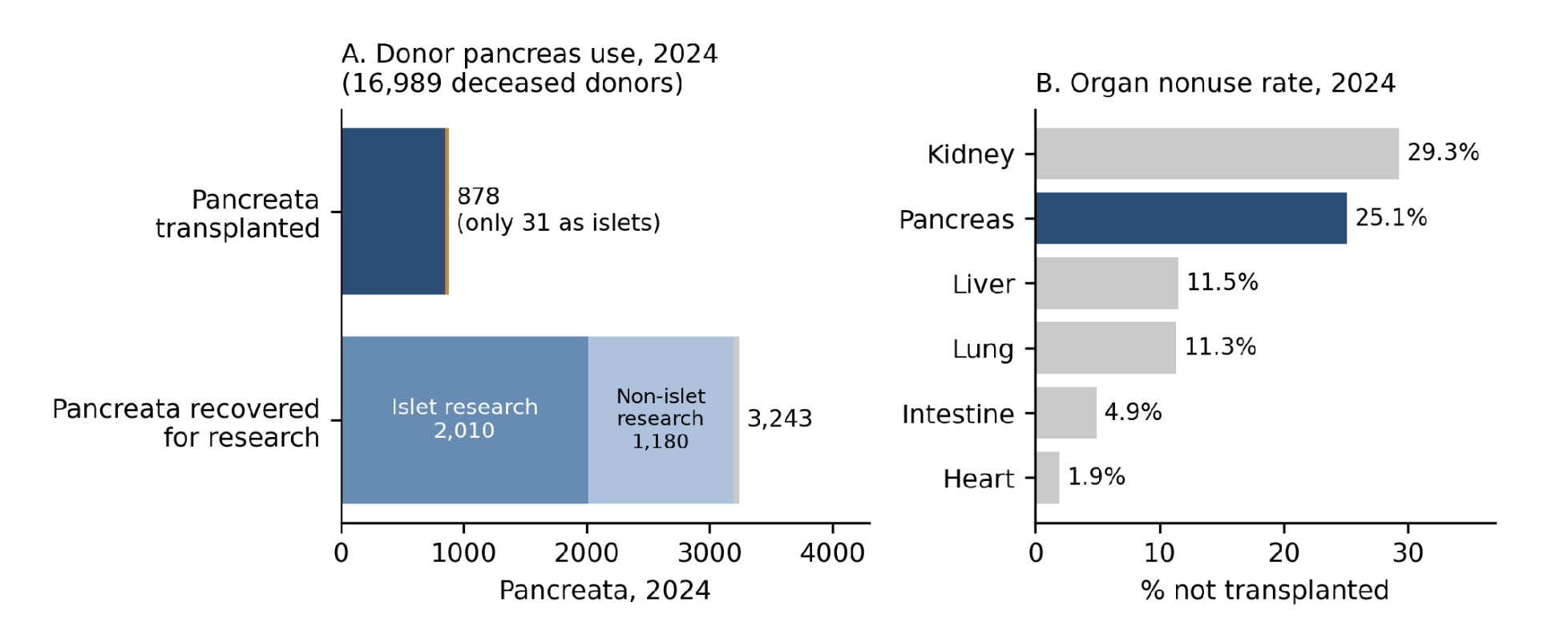
Figure 1. Deceased-donor pancreata are largely unused for transplantation (United States, 2024). (A) Of 16,989 deceased donors, 878 pancreata were transplanted (31 as islets), while 3,243 pancreata were recovered for research (2,010 accepted for islet cell research, 1,180 sent for non-islet research, 53 not used). (B) Percentage of organs recovered for transplant that were not transplanted, by organ. Data from the OPTN/SRTR 2024 Annual Data Report, Deceased Organ Donation chapter (Figures DD 18 and DD 25) and Pancreas chapter (Figure PA 72); redrawn. [25,26]
Faster, accountable allocation. Under OPTN policy, pancreata could be offered to islet programs through the national match system, with defined criteria for whole-organ versus islet use, instead of through ad hoc research consent and bilateral arrangements. Shorter placement times mean shorter cold ischemia, which directly affects islet yield.
A path to coverage. Recognition as organ transplantation would allow islet procurement and processing to be addressed within established organ-acquisition cost and transplant coverage structures, subject to CMS and payer action. Outside NIH-sponsored trials, there is effectively no reimbursement route today.
International benchmark. Canada, France, Italy, Switzerland, the United Kingdom, and Australia deliver islet transplantation as reimbursed clinical care under transplant or tissue frameworks. [13,14]
The BLA requirement has placed a high, fixed development and maintenance burden on academic transplant programs that work with scarce and variable donated pancreata. Our March 2025 FDA letter warned that reliance on a single licensed commercial supplier could constrain center participation and pricing; HHS should test that concern against actual supply, contracting, and utilization data, rather than presume monopoly or unsafe product quality from licensure alone. [2] The United States has approved one deceased-donor islet product, Lantidra, yet licensure alone has not established broad patient access. At the same time, I do not claim that regulatory classification is the sole cause of low transplant volume. Organ supply, isolation capacity, transplant infrastructure, reimbursement, and the burdens of immunosuppression also matter. [2,9]
To answer HHS’s causal question rigorously, I recommend that FDA, HRSA, CMS, centers, organ procurement organizations, and payers assemble annual, center-level data on potential donor pancreata, offers and acceptance, isolation attempts and yields, IND and BLA costs, qualified center capacity, referral-to-treatment time, insurance decisions, transplants performed, outcomes, and reasons a procedure could not proceed. Compare U.S. trends before and after licensure with jurisdictions using tissue or transplant frameworks, adjusting for donor supply and payment. Publish the underlying definitions and methods. Such a study can identify the incremental effect of the current regulatory route and guide an honest forecast of what reclassification would achieve.
A transition must also address payment. Congress has required Medicare coverage for islet transplantation in the context of an NIH-sponsored clinical trial; moving to an organ pathway will not by itself settle coverage outside that setting. HHS should ask CMS and private payers to develop coverage and reimbursement rules in parallel with HRSA policy. [11]
Restoring U.S. leadership in cellular therapy
HHS should also weigh a consequence of the current classification that reaches beyond individual patients: the erosion of U.S. leadership in beta-cell replacement and, more broadly, in cellular therapy. Much of the foundational science of clinical islet transplantation, including automated isolation, was developed in U.S. academic centers and adopted by programs worldwide. [19] Today the clinical practice has largely moved abroad. U.S. centers performed 179 islet allotransplants between 1999 and 2005, but only 11 new patients were transplanted between 2016 and 2019. [12] Over the same era, the Edmonton program alone has treated 330 patients with roughly 780 transplants, as publicly funded standard care since 2001. [13] France, through its national islet network, has performed more than 300 islet transplants and has made the procedure reimbursable under national health insurance. [14,18] In China, the islet program at Shanghai Changzheng Hospital, whose team I trained in 2018, has since performed approximately 310 islet transplants, more than all U.S. centers combined have been permitted to perform over the same period [verify against CITR and Lantidra totals, 2018–2026]. Islet transplantation is also reimbursed in Australia, Italy, Switzerland, and the United Kingdom. [14]
This gap matters for innovation, not only for access. An active clinical islet program is the infrastructure on which the next generation of therapies is tested. It brings together qualified isolation facilities, experienced surgical and endocrine teams, a steady flow of procedures, patients followed for years, and outcome registries. Within that setting, new implantation sites, immunomodulation and tolerance protocols, regulatory T-cell therapies, encapsulation devices, and engineered cells can be evaluated efficiently as investigational arms. Where routine transplant volume exists, these studies are fast and affordable. Where it does not, they have no home.
The consequences are already visible. The first transplant of gene-edited, hypoimmune donor islets without immunosuppression was sponsored by a U.S. company but performed at Uppsala University Hospital in Sweden, relying on that country’s established islet program, and was published in the New England Journal of Medicine. [15] The Shanghai Changzheng team built on its clinical base to lead the first clinical studies of transplanting islets regenerated from a patient’s own stem cells. [17] Separately, investigators in Beijing and Tianjin reported sustained insulin independence after transplanting islets derived from a patient’s chemically reprogrammed stem cells. [16] These products appropriately remain under drug-level oversight wherever they are tested. The point is that the clinical ecosystems that made these first-in-human studies possible were built on routine islet transplantation. U.S. expertise helped build these programs abroad, while U.S. patients and centers have been unable to use it at home. All such programs, abroad and at home, must rest on ethically sourced, consented donation; the U.S. system’s standards in that regard are a strength to build on, not a reason to cede clinical leadership.
The United States has allowed its own ecosystem to atrophy. Each year without clinical volume, isolation teams disband, expertise ages out, and trainees and sponsors go abroad. [20]
Reclassifying unmodified deceased-donor islets would not relax oversight of novel products. Engineered, expanded, and stem-cell-derived therapies would still enter clinical testing under FDA investigational requirements. But they would enter U.S. centers that have experienced teams, qualified facilities, OPTN-linked donor supply, and longitudinal registries. I urge HHS to include competitiveness measures among its benchmarks for this policy: the number of active U.S. islet programs, the number of first-in-human cellular therapy trials conducted domestically versus abroad, and the retention of trained isolation and transplant personnel.
Practical OPTN oversight Questions B4 B6 to B9 B11
HRSA and OPTN should establish a designated pancreatic-islet program category, with accredited or otherwise independently inspected isolation laboratories and affiliated transplant hospitals. The revised pathway should permit multiple qualified isolation and transplant centers to participate, including centers that use appropriately qualified external isolation facilities, with transparent performance review rather than exclusive control of donated pancreata by any one entity. A national expert committee should include transplant surgeons, endocrinologists, islet-isolation specialists, microbiologists, quality specialists, organ procurement organizations, and patient representatives. Policies should address donor-to-recipient allocation, criteria for using a pancreas for whole-organ versus islet transplantation, multi-donor infusions, equitable access, and clear financial rules for procurement and processing.
For each transplant, require documented donor and recipient eligibility; batch records and release authorization; independent quality review; chain of custody; reportable deviations; look-back and recall procedures; investigation of possible donor-derived infection; and a linked, longitudinal recipient registry. Outcomes and adverse events should be auditable at the facility and national levels, with inspections, corrective actions, and public aggregate reporting. HRSA will need dedicated staff, information systems, specialist expertise, and a transparent budget rather than an unfunded mandate to OPTN members. FDA should cooperate on transition standards and continue regulating the products and activities that remain within its jurisdiction.
Several islet-specific safeguards deserve explicit attention. First, allosensitization: recipients of islets, particularly from multiple donors, can develop donor-specific HLA antibodies that may complicate a later kidney transplant. Policy should require HLA antibody monitoring and disclosure of this risk at consent. Second, national patient-selection criteria for islet-alone transplantation, under which any one of the following is sufficient on its own to establish eligibility: failure to achieve metabolic control with exogenous insulin treatment, and/or recurrent severe hypoglycemia, and/or hypoglycemia unawareness despite optimized care. Selection should be paired with a standardized consent covering immunosuppression, procedural risk, and the variable durability of insulin independence. Third, program accountability comparable to solid-organ transplantation: minimum proficiency standards and program-specific outcome reports through the Scientific Registry of Transplant Recipients, with performance thresholds that trigger review. Fourth, registry continuity: the data elements of the Collaborative Islet Transplant Registry should be carried into OPTN and SRTR systems so that reclassification does not create a reporting gap. Fifth, mandatory reporting of procedure-related complications, including portal-vein bleeding and thrombosis.
Reclassification should preserve the status and rights of existing license holders and investigational sponsors unless and until HHS explains, through a legally sound transition, how their products and obligations are affected. The ISLET Act can provide legislative clarity if needed, while HHS evaluates its authority under the existing organ-transplant statute and OPTN regulations. I ask HHS to publish a proposed definition, an agency-responsibility map, an implementation schedule, and measurable access and safety benchmarks for public comment before final action.
Requested action
Please move forward with a narrow organ-transplant pathway for isolated, otherwise unmodified deceased-donor islets; establish the safety and quality architecture described above; coordinate reimbursement and access monitoring from the outset; and treat the restoration of U.S. clinical islet programs as a foundation for national leadership in cellular therapy. I would welcome an opportunity to provide CIT protocol and manufacturing materials, center-level operational information, and expert input to the public record where release of those materials is authorized. Patients with recurrent severe hypoglycemia deserve access to an evidence-based therapy through a system that protects donors and recipients and can be sustained across qualified U.S. transplant centers.
Respectfully,
Camillo Ricordi, MD
Professor of Surgery and Chief, Division of Cellular Transplantation
Director, Cell Transplant Center; Director Emeritus, Diabetes Research Institute
University of Miami Miller School of Medicine
Selected sources for the administrative record
[1] Ricordi C, Witkowski P. Islets for US Collaborative letter to Secretary Becerra, May 4, 2021. https://www.isletsforus.org/_files/ugd/e04a06_ddeea3c16f564620bd2f7884acfeca96.pdf
[2] Witkowski P, Ricordi C. Islets for US Collaborative letter to FDA Commissioner Makary, March 30, 2025; and letter to Secretary Kennedy, March 11, 2026. https://www.isletsforus.org/_files/ugd/e04a06_7b8a0ea702304b9b9f31f8287a349acd.pdf
[3] Witkowski P et al. Arguments against the Requirement of a Biological License Application for Human Pancreatic Islets. J Clin Med. 2021;10:2878. doi:10.3390/jcm10132878.
[4] EMA Committee for Advanced Therapies. Reflection paper on classification of advanced therapy medicinal products. EMA/CAT/600280/2010 rev.1. https://www.ema.europa.eu/system/files/documents/scientific-guideline/wc500187744_en.pdf
[5] EMA Committee for Advanced Therapies. Scientific recommendation on classification of human islets of Langerhans, 2011. https://www.ema.europa.eu/en/documents/report/scientific-recommendation-classification-advanced-therapy-medicinal-products-human-islets-langerhans_en.pdf
[6] Hering BJ et al. Phase 3 Trial of Transplantation of Human Islets in Type 1 Diabetes Complicated by Severe Hypoglycemia. Diabetes Care. 2016. PMID:27208344. https://pubmed.ncbi.nlm.nih.gov/27208344/
[7] Ricordi C et al. NIH-Sponsored CIT Consortium Phase 3 Trial: Manufacture of a Complex Cellular Product at Eight Processing Facilities. Diabetes. 2016. PMID:27465220. https://pubmed.ncbi.nlm.nih.gov/27465220/
[8] Markmann JF et al. Phase 3 trial of human islet-after-kidney transplantation in type 1 diabetes. Am J Transplant. 2021. PMID:32627352. https://pubmed.ncbi.nlm.nih.gov/32627352/
[9] HHS, FDA, HRSA. Improving Patient Access to Deceased Donor Islet Cells and Cell Products; Request for Information. 91 FR 60632 (Sept. 24, 2026). https://www.federalregister.gov/d/2026-19563
[10] Monserrat N. Islet transplantation in the United States – Quo Vadis? An interview with Camilo Ricordi, Ali Naji, Peter Stock, and Piotr Witkowski. Transpl Int. 2021;34:1177–1181. doi:10.1111/tri.13931.
[11] Medicare Prescription Drug, Improvement, and Modernization Act of 2003, section 733; described in 91 FR 60632.
[12] Witkowski P, Philipson LH, Kaufman DB, et al. The demise of islet allotransplantation in the United States: a call for an urgent regulatory update. Am J Transplant. 2021;21:1365–1375. doi:10.1111/ajt.16397.
[13] Alberta Health Services. World’s largest islet transplant program celebrates 25 years. June 2025. https://www.albertahealthservices.ca/news/Page19110.aspx
[14] Bottino R, Knoll MF, Knoll CA, Bertera S, Trucco MM. The Future of Islet Transplantation Is Now. Front Med. 2018;5:202. doi:10.3389/fmed.2018.00202.
[15] Carlsson PO et al. Survival of Transplanted Allogeneic Beta Cells with No Immunosuppression. N Engl J Med. 2025. doi:10.1056/NEJMoa2503822.
[16] Wang S et al. Transplantation of chemically induced pluripotent stem-cell-derived islets under abdominal anterior rectus sheath in a type 1 diabetes patient. Cell. 2024;187:6152–6164.
[17] Wu J et al. Treating a type 2 diabetic patient with impaired pancreatic islet function by personalized endoderm stem cell-derived islet tissue. Cell Discov. 2024;10:45.
[18] [To be supplied: French national islet network (GRAGIL) or Agence de la Biomédecine activity report documenting more than 300 islet transplants and the 2021 reimbursement authorization.]
[19] Ricordi C, Lacy PE, Finke EH, Olack BJ, Scharp DW. Automated method for isolation of human pancreatic islets. Diabetes. 1988;37:413–420. See also: Ricordi C. The Cure of Diabetes: role and global impact of the Ricordi Chamber – 40th Anniversary Celebration
. https://www.youtube.com/watch?v=iz6aRrPHLjs
[20] Witkowski P, Wojcik N, Appelbaum N, Fung JJ, Barth RN, Ricordi C. Demise of cadaveric islet transplantation in the USA: Quo Vadis, 1 year after BLA approval and 24 years after the Edmonton breakthrough? Front Transplant. 2025;4:1491568. doi:10.3389/frtra.2025.1491568.
[21] Witkowski P, Barth RN, Japour A, Pyda J, Bachul P, Ricordi C Regulatory updates are needed to prevent the commercialization of islet transplantation in the United States. Am J Transplant. 2021;00:1–3. DOI: 10.1111/ajt.16555
[22] Walker JT, Saunders DC, Brissova M, Powells AC. The Human Islet: Mini-Organ With Mega-Impact. Endocrine Reviews, 2021, Vol. 42, No. 5, 605–657. doi:10.1210/endrev/bnab010
[23] Weir GC, S. Bonner-Weir S. Why pancreatic islets should be regarded and regulated like organs? CellR4 2021; 9: e3083
[24] Abdulreda MH, Berggren PO The pancreatic islet: a micro-organ in control. CellR4 2021; 9: e3093.
[25] Israni AK, et al. OPTN/SRTR 2024 Annual Data Report: Deceased Organ Donation. U.S. Department of Health and Human Services, Health Resources and Services Administration; 2026. https://srtr.hrsa.gov/adr/2024/DOD
[26] Kandaswamy R, Stock PG, Miller JM, et al. OPTN/SRTR 2024 Annual Data Report: Pancreas. U.S. Department of Health and Human Services, Health Resources and Services Administration; 2026. https://srtr.hrsa.gov/adr/2024/Pancreas/